Each instalment of this newsletter looks at a year in my life through the lens of a song by John Darnielle, and for the next few updates, I’ll be varying the format, pairing each song with a poem I wrote that year.
The poems might not always speak to the songs directly, but my idea here is that they’ll be in the room with each other, sharing the same air, as two creative objects that came into being at about the same time. Graham Greene’s first volume of memoir, A Sort of Life, took him up to the age of 24: beyond that, he said, his life was in his books. Having written about my first twenty-three years, I’ve reached the point where I was regularly publishing work I still have mostly positive feelings about, so it seems logical from now on to start counterpointing two bodies of writing, rather than one artistic corpus and one listener’s life.
Since I imagine most of you came here initially for the Mountain Goats in any case, I hope this will help me keep the balance right until the end of the project, with about a thousand words on each song segueing into the year’s poem at the end of the newsletter. To maintain the personal aspect, I’ll mostly be sharing poems that either weren’t published, for whatever reason, at the time, or never made it into the full pamphlets of my work that you can find online for reasonable prices - out-takes and non-album tracks, if you will - which, correspondingly, I’ve mostly forgotten writing, which means they should be interesting to reflect on a few years’ distance.
The subject of today’s post is a young man at a similar hinge-point in his life, the 22-year-old Ozzy Osbourne.
In his obituary for Ozzy - one of many musicians who had a formative impact on his own work and preoccupations - John Darnielle refers in passing to ‘the disparity’ between the Satanic tropes of Ozzy’s public image and ‘the encouraging, hopeful, ultimately Christian nature of [Geezer] Butler’s lyrics.’ Neither God nor the Devil are overtly present in ‘Song for Black Sabbath’s Second North American Tour,’ but hope is there, as it so often is, in the image of ‘a body in motion.’
The version of Ozzy who narrates the song views himself as ‘Not long for this world,’ having to be reminded to ‘stay away from windows’ - because something in him, clearly, is pulling him towards them. And yet the international tour he is embarked on, a sign of his band’s growing significance, seems to allow him to leave at least a few ‘important things behind’ him for good - including, at age sixteen, a job in a Digbeth slaughterhouse which involved first ‘removing puke from sheep’s stomachs’ and then killing cows, coming home with ‘the smell of death’ in his clothes. ‘Hang my hammer on a nail,’ Darnielle-as-Ozzy begins - another subjectless verb which brings the listener startlingly close to the heart of the action - ‘Never see it again.’ And he wouldn’t: that part of his life was over.
After Ozzy’s turbulent adolescence in industrial Birmingham, including six weeks serving time for burglary in Winson Green Prison (which I used to pass on the Soho Loop when I started running along the city’s canal towpaths a few years later), Darnielle summarises in a live introduction how music offered him an alternative path: ‘his father bought him a PA to try to keep him at home.’ Within a few years, he ‘wound up touring the world,’ and this song registers the profound ‘shock’ of that transition with a kind of sprightly, skipping wonder.
There are obvious resonances here with Darnielle’s own, surprising-to-himself, survival and eventual career: in that live performance, recorded in Chicago in 2018, he jokes that ‘me and Ozzy’ would be a valuable subject to unpack in therapy, and elsewhere has described writing songs about the Sabbath frontman as an ever-present potential ‘pastime.’ Ozzy became ‘sort of a talisman’: a person who ‘was supposed to spend most of his life in jails or institutions and die young’ - like, say, Billy the Kid - ‘but that’s not actually what happened.’ Instead, as the obituary lovingly notes, the music Ozzy went on to make became work that would ‘speak to’ listeners like Darnielle in his own ‘harder years,’ ‘in our time between stations, surrendering out of necessity to the uncertain motion of the moment—that moment of need, not for direction but just for the voice of someone who sounded like he understood.’
Even down to its little guitar riff, suspended seconds and fourths twinkling in and out of the tonic D chord, the song embodies that feeling of surrendering to ‘uncertain motion.’ The slaughterhouse, and the ‘beaten-down men’ to be found there and everywhere, are slipping out of sight as Ozzy ‘set[s] sail above the cosmos / High above the world.’ The phrase hints towards the psychedelic expansion that Darnielle considers from various angles on ‘Passaic, 1975’ - a song about Osbourne four years later, itself first heard in 2015, who is telling the world ‘I want everyone to get high’ while pursuing his own ‘assault on my lungs and my liver’ that leads him to ‘wake up coughing up blood.’ But here the important thing is simply getting up and away: that grim life in Birmingham and all the world’s miseries, internal and external, will soon be ‘all gone with the dawn.’
‘And then I’m in an airplane heading west,’ the third verse begins, with a jolt like coming back to the body - weren’t you already setting sail, high above the world? - returning us to the pragmatic specifics of a journey which is mundane as well as cosmic. Like the impression the Throgs’ Neck Bridge made on the young Darnielle on his first East Coast Tour, the world is full of novelty, and I hear a certain amazement in that drawn-out, descending word ‘west’ (particularly as it’s sung in the 2018 Chicago version.) ‘So far from the slaughterhouse,’ Ozzy and his bandmates have either become, or are about to encounter, ‘New creatures with new hearts,’ and he will personally no longer be engaged in the messy business of stopping hearts from beating. As their plane descends, Black Sabbath’s career is moving in the opposite direction: ‘Landing at LaGuardia / Tearing up the charts.’
And yet this, too, will be ‘all gone’ - a phrase which also appears in the song Beat the Champ’s ‘Luna,’ just a year later. Poverty and misery have been left in the rearview; success and stardom, in the long run, will meet the same fate. But as befits the way Darnielle eulogises Ozzy, we end on a note not of ‘alienation and frustration’ - central as those themselves have been to both artists’ work - but warmth and recognition, within a sonic palette which channels not the ‘drenched in doom’ aspects of Black Sabbath, but the tenderness with which the songwriter regards their legacy. Osbourne lived a long and fulfilling life: the song captures a part of it, a moment of elation and novelty and going-somewhere-elseness, tracking one swift movement across the sky before whatever it represents ‘steals into the dawn, and then it’s gone forever.’ Listening to it you might feel, however briefly, like you have a new heart too.
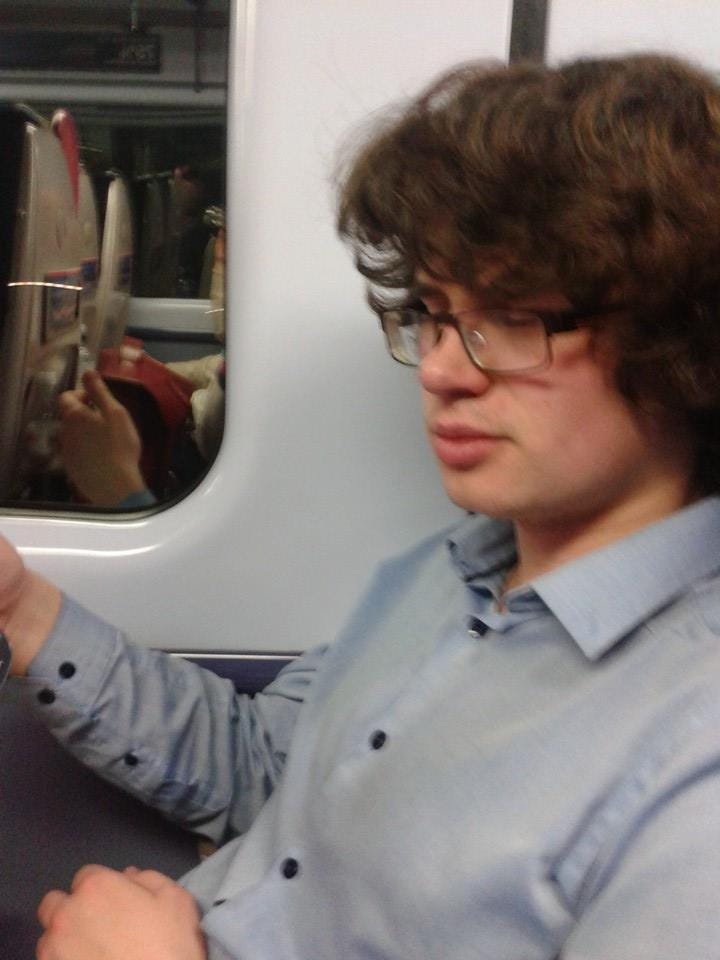
Here’s a picture of me on a train back to Stratford from somewhere, taken by a friend from my MA course: a body in motion. I wasn’t coming from Stockholm, but I had been there three years earlier and in 2014, for an anthology submission, I wrote something about the Dance Museum there. It’s a nervy, slightly convoluted piece, coming out of a nervy, slightly convoluted mind, but I can still enjoy the winding movement of it, the way it tries to make sense of movement itself, stasis and change. Two days after writing this, I’ll be travelling home from the writing residency where I’ve spent this month, ‘on an airplane heading west,’ and I’m looking forward to being back in Newcastle with my wife and my cats, steady on my feet again.
Dansmuseet

	Not that I would have wanted it to be,
or last much longer than its natural term;
	this is where it became
the stapling of motion on a sheet,
	the crucifixion of ball-change and turn.

	Like wings hanging from coat-hooks on the wall,
the gauze and masks, the figures caught en pointe
        are braced like catgut strings –
somewhere between still lifes and wind-up dolls,
	shins taut to catapult into the void.

	This is, of course, an arbitrary point:
we’d wound ourselves up into arabesques,
	but when I held the thread
and snipped it, it was senseless to recoil.
	The flower doesn’t choose when to be pressed:

	I can’t retrace one step, and if I could,
I wouldn’t. This is how it works:
	one foot moves first,
the other follows, trusting that what’s good
        cannot at once be spinning and preserved.
This week, Richard is getting into Lutheran communion rails.