In late 2014, a reviewer in the Times Literary Supplement described my work as exploring ‘what Oscar Wilde called “the truth of masks”.’ Since this was an appraisal of a pamphlet of love poems, I wasn’t totally sure what to make of the comparison, but looking back I can see how ‘a sense of performance and display’ did animate how I was writing then. Many of my poems, like the one I shared in the previous newsletter, worked like little machines, self-consciously artful to the point of fussiness. They took on historical personas, or honed in on unusual stories from podcasts; they imitated the forms of medieval and early modern poets, sometimes more overtly than others; they borrowed old frameworks and attitudes which I tried, not always successfully, to apply to new contexts. Even when I was writing about genuine personal feelings, this placed some distance between raw reality and the reader. Perhaps a focus on playing a role on the page was one way of mitigating the risks of making the personal public, though as a young poet who liked the Metaphysicals and was quite attached to the idea of the ‘conceit,’ I mostly felt I was having fun with the kind of larger-than-life extravagance my poetic heroes had always indulged in.
Around the same time, the Mountain Goats released a batch of songs themselves deeply concerned with performance and the personal, with what you show and what you keep back. Given that the writing process apparently began with the hushed and chilling ‘Hair Match’ (‘Buzzing razor held aloft and just about to strike, I loved you before I ever even knew what love was like’) it’s not surprising that themes of vulnerability and perception peek through almost every song on Beat the Champ, but ‘Unmasked!’ - a close cousin to that stark track, sonically - looks the subject squarely in the face.
A friend in 2015 directed me towards Roland Barthes’s essay ‘The World of Wrestling,’ which observes how these staged matches present ‘man’s suffering with all the amplification of tragic masks.’ Barthes describes the grand, signifying gestures which make up this ‘great spectacle of Suffering, Defeat, and Justice,’ and it’s easy to imagine John Darnielle nodding along with his comparison between ‘truth’ in wrestling and in Greek theatre: ‘In both, what is expected is the intelligible representation of moral situations which are usually private. This emptying out of interiority to the benefit of its exterior signs, this exhaustion of the content by the form, is the very principle of triumphant classical art.’
Darnielle’s liner notes for the album make clear his investments in the exaggerated quality of wrestling narratives, during his ‘hyper-fandom’ between the ages of nine and thirteen: ‘These were comic-book heroes who existed in physical space. I was a child. I needed them, and, every week, they came through for me.’ While his home life had a ‘chaotic and frightening’ atmosphere, justice could be experienced through the spectacular interventions of a figure like Chavo Guerrero ‘coming off the top rope.’
Darnielle loved to see the heels ‘punished’ even if the apparent rules of the game were transgressed: ‘When, in the heat of battle, the good guys would abandon the rulebook in order to fight fire with fire, something inside me responded primally.’ (When a ‘villain’ is ‘pursued’ outside of the ring, writes Barthes, ‘the crowd is jubilant at seeing the rules broken for the sake of a deserved punishment’: as befits ‘a spectacle and not a sport,’ fights sometimes end in ‘a sort of unrestrained fantasia’ where the rules are ‘swept away by a triumphant disorder,’ existing at ‘the very limit of the concept of Justice.’
Many of the album’s most high-octane songs - ‘Choked Out,’ ‘Heel Turn 2,’ ‘Werewolf Gimmick’ - revel in the wild emotions of that ‘outermost zone of confrontation’: characters ‘learn to love’ the ‘red mist,’ become ‘at one, for once, with the universe’ by throwing themselves down ‘an endless dark incline’ to the sound of screaming crowds. The moral certainties of a ‘child’s mind’ are gleefully stomped by a newly-turned heel ‘torch[ing] the bridge’ of the fans’ admiration in order to make it out ‘in one piece.’ These correspond, of course, with Darnielle’s awareness that his listeners have always liked him to ‘get blood on the front row,’ but across the thirteen tracks, the now four-piece band testify again to their expanding ambitions.
‘Fire Editorial’ shows the influence of Steely Dan, long a lyrical touchpoint for Darnielle, in its complex rhythms, while ‘Stabbed To Death Outside San Juan’ incorporates layers of organ, strings and woodwinds (courtesy of new member Matt Douglas) to create the foreboding, lurching, knife-edge atmosphere that you might expect from the menacingly strange phrase ‘Twitch when the contact howls.’ The songs which cut the deepest for me now, however, are those where the writer’s assertion that the album is ‘really more about death and difficult-to-navigate interior spaces than wrestling,’ and that its lyrics are ‘rather more emotional than you might guess at first blush,’ feel closest to the surface. Wrestling was ‘a point of contact,’ as the liner notes put it, between Darnielle and his violent stepfather, and its game of masks must have struck him as one way of responding to the ‘challenge’ of how to ‘state simply what things were like between my stepfather and me.’
‘Unmasked!’ frames these two figures centrally, as ‘the real two’ around whom a ‘cast of thousands’ mill, but in this scene never really intrude. Like ‘Hair Match,’ it dwells - at a measured pace, with gently double-tracked vocals and sparse, lingering piano notes adding to the sense of a late-night glimpse at something strange and significant - on a moment of defeat: one of Barthes’s central, capitalised terms (as translated by Annette Lavers). The punishment of the losing wrestler ‘enacts the exact gestures of the most ancient purifications,’ like ‘the cross and the pillory.’
Both the removal of the loser’s mask and the shaving of his head take place, in Darnielle’s narratives, in an unnervingly quiet atmosphere, before a depleted audience: ‘Crowd’s half-gone, just a few hangers-on’; ‘some people leave before it’s over … some hide behind their programmes, some turn away.’ In the insular Southern California leagues of the 1980s, Darnielle comments, the ritualistic shaving would take place on ‘the cheapest chair they could find … And because in those days they weren’t doing it for TV, the people tended not to cheer. They just watch.’
And here we are, as listeners, just watching a moment of extraordinary intimacy, the victorious narrator ready to ‘finally tear through the stitching at last’ and reveal the true face of his tormenter. The album’s paratexts make the connection clear - this song reflects the exposure of something real, personal and uncomfortable about Mike Noonan, who took Darnielle to these wrestling matches, and whose transgressions have been known to the Mountain Goats’ audience since Darnielle’s momentous decision to write openly about his childhood on The Sunset Tree. And so, just as there might always be someone secretly recording the supposedly private humiliation of a hair match, the song reckons with the discomfort of making Noonan’s treatment of his family public knowledge.
Doing so is justified, Darnielle’s narrator asserts, ‘by way of honouring the things we once both held dear,’ which refers perhaps less to wrestling than to the political and social values his stepfather - a committed, leftist union leader who beat members of his own family - aimed to instill but often failed to embody. He presents the removal of a mask as a kind of relief: ‘Like you’re free, like you can breathe now.’ But that act is also reflected back on the person doing the exposing, casting the relationship between them in a more complex light: ‘trying to say goodbye / The only way I know how / Crude and graceless … when I’m alone / Before a mirror late at night / I will reveal you.’
Having chosen, some twelve years earlier, to reveal something about himself and his family in the ‘confessional turn’ which produced the Healed and Sunset Tree albums, Beat the Champ finds Darnielle looking back on that process from new angles, and exploring what it means for ideas of love and heroism to be shaped in the atmosphere of violence, both private and public, real and performed. The result, as much as anything on Get Lonely, is a foregrounding of vulnerability, of what it means to appear, either in a constructed persona or maskless, exposed, before an audience who may or may not be recording, who may be attending to the spectacle of suffering for a divergent range of personal reasons.
A few songs earlier, the wrestler Luna Vachon - watching her own past go up in flames before her during a tragic house fire - asserts that she is ‘strong now.’ That phrase is reiterated in 2023’s ‘From the Nebraska Plant’ (‘I am strong now - that was all years back’) and evoked again in a key couplet on the new album Through This Fire Across From Peter Balkan where strength and vulnerability are acknowledged in rapid succession, two sides of the same coin, two essential human experiences which each have their own role to play in the story:
The first thing you learn is how strong you can be if you have to
And the next thing you learn is how cold it can get at night.
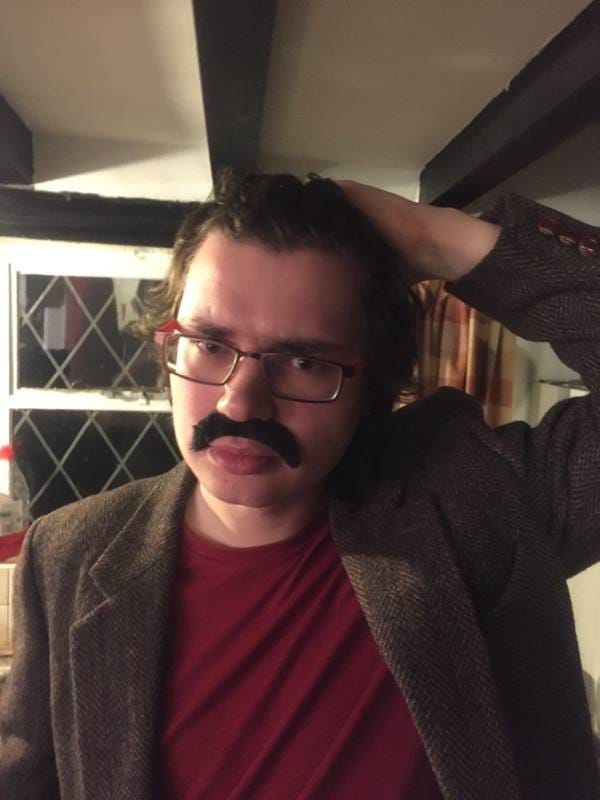
In February 2015, I uploaded a picture of myself in costume at a party, wearing a fake moustache and some kind of woollen jacket, with the caption ‘Me in twenty years’; I’m including it here because I’m surprised at how much more it looks like me now than anything else I can find from that year - as if the rest of the time I was wearing a mask without knowing it. In October of the same year, I wrote a poem about Oliver Cromwell’s son Richard, the doomed and ill-equipped inheritor of his father’s role as Lord Protector during the English Interregnum. A lot of the ideas in it came straight from Wikipedia, and although I now know much more about the Civil War than I did ten years ago, as a result have become quite mysterious to me. What that means in practice is that I mostly recognise the glimpses of truth in there, the parts which seem like they’re actually about me.
Queen Dick
You, iron-fist, you, pugilist,
you cramming my round head with facts,
your disappointment curdling like milk.
I roam the Palace under house arrest,
a prisoner of (you’d say) my idleness.
I pick up trinkets; put them down again.
I feel the Army breathing down my neck,
imagine Christmas:
                                	you downstairs,
writing a multi-tome treatise entitled
How to Ruin Everything
for Everyone, while in my room
I wolf down goose by guilty candle-light,
you flesh and blood, the axe laid to the root.
*
In France, signing a false name
to the wife I’ll never see again,
without the seal you polished and they smashed,
I hear they’ve hauled you from the earth,
hoisted you like a rebel flag,
and know my presence was a weakening –
me falling off my horse again,
my warship glugging Channel bilge,
I was the one thing you could not protect.
*
At law against my daughter
for the lands wrecked by my feckless son
whom I (of course) named Oliver,
I feel you in my blood and dream of spikes.
These days I’m lodging with a friend.
I’m eighty-five in Hertfordshire
and hunting nothing but my breath,
the vain spirit trapped in my throat.
In unobtrusive farmer’s clothes,
I praise your God of intermittent Love.
This week, Richard is getting into a batch of flapjacks my wife made - they’re really good!