

Wonderful though it would be to be able to declare, like Bob Dylan in ‘My Back Pages,’ that ‘I was so much older then / I’m younger than that now,’ each of us is bound to live our own life in linear order: to learn, as Theodore Roethke put it in his villanelle ‘The Waking,’ ‘by going where I have to go.’ The Mountain Goats’ discography has extensively explored the ‘twisting alleyways’ which people sometimes follow towards their current station, including the twisty question of when you start to look back, and how far. After all, John Darnielle released about thirteen years of music before turning his lyrical lens on himself; and as I discussed last time, the retrospective strain in his work started, in the late 2010s, to also become increasingly self-reflective.
John’s interviews, particularly with the podcaster Joseph Fink, around the 2019 album In League with Dragons show how consciously he was now thinking about his own history not only as an autobiographical subject, but as a writer and performer whose work moved steadily towards foregrounding those themes. ‘Done Bleeding,’ the opening track of that record, sees Darnielle in the studio in 2018 taking stock of everything that got him to that point, reflecting on ‘the songs that kept me whole’ from his ‘lonely tenure’ as a nurse in employee accommodation, in a block which formerly housed patients on the grounds of the Metropolitan State Hospital in Norwalk, to the present day of this very composition: ‘try to let them all flow into this one.’
The lyrics contemplate wryly what the Mountain Goats’ first efforts must have sounded like to his neighbours, ‘finally taking their earplugs out’ when he left that space of ‘incubation’ behind. They also celebrate, more metaphorically, no longer being in that space any more, moving on from the years of various kinds of more and less direct self-harm which led up to his time in Norwalk: ‘Let the crust form on my skin in the sun / When I get done.’ A thread is woven between personal healing and a broader narrative of trying to make small improvements to the world around you, with a phrase familiar from Ezra Pound’s polemical approach to poetry applied to a more considerate, domestic context: ‘Sweep the front porch, make it new.’ Everything is in the service of one, socially-oriented goal: ‘Leave the old place nicer than I found it.’
‘Younger,’ first played live at a solo show in Mobile, Alabama in February 2018, sees Darnielle engaging with the history of his own art-making still more explicitly. The song’s main riff, as its writer discusses at length on Fink’s podcast, pays tribute to an earlier composition, ‘No I Can’t,’ recorded on ‘the seventeenth of December,’ 1992, ‘at nine thirty four in the morning’ - studio dates for its latter-day counterpart are not quite so forthcoming. Darnielle is keen to point out the increased technical complexity of its cycling chord extensions, and the greater rhythmic dexterity required to play it: both are indications of how far his work had evolved in the intervening twenty-five years, as more and more elements came to seem first desirable and then necessary to realise his expanding vision for what was once a deliberately restricted sonic world.
You can hear that more mature mindset all across the album, as musical ideas come in the frame which it would have been hard to imagine on a Mountain Goats album ten or fifteen years earlier. The contributions these make are particularly striking on a song which revisits an older, starker scene of domestic deprivation, defined like much of the early work by Darnielle’s raw tenor and battered acoustic guitar clanging through the changes. But all across In League with Dragons, we now find jazzy piano flourishes; an extended sax solo; smooth vocal reverb; pedal steel; and The Macedonian Radio Symphonic Orchestra. Now I have everything I need. Now I have everything I need.
What we need, of course, is always changing in response to our circumstances, as artists and as people; two years later, for the rapid-response pandemic project Songs for Pierre Chuvin, the dusted-off Panasonic boombox would once again be the only equipment Darnielle required, while Bleed Out two years on from that would make electric guitar a newly prominent feature. The more sedate and mannered style of In League with Dragons, on first hearing, felt a long way off from what first drew me to the band, and it never became one of my favourites among their albums. It remains, nonetheless, one of the Mountain Goats’ most sonically ambitious departures, a sign of how far Darnielle, after a decade and a half acclimatising to full studio production, was now trying to push himself - including by handing over more musical duties to an expanded team of session players, with few of the guitar parts on the released album being played by the songwriter himself.
The lyric for ‘Younger,’ however, is all Darnielle: an older man pulling together various strands from his earlier work, most obviously the reference back to the title track of ‘Get Lonely’: ‘It never hurts to scan the windows on the upper floor / I saw a face there once before when I was younger.’ As Alex Russell writes on his blog A Few Things, Maybe Several Things, ‘the power of a reference like this is that it isn’t just something to figure out. It’s not just a line cribbed from another song. It’s a direct statement that we’re further along in the timeline of who John Darnielle is.’
As much as John, in a recent extended profile piece in GQ and in many interviews over the years, resists the urge to place him personally at the centre of his art, this song relies on the knowledge that the same person wrote ‘Get Lonely’ and is writing this now; it’s further enhanced by our sense of ‘Get Lonely’ itself as a partial portrait of Darnielle’s time in cold Chicago in the early 90s. And yet, lest we let the paratexts take over completely, we shouldn’t forget that these moments of self-reference - which lay the ground for even clearer ones in the likes of ‘Exegetic Chains’ and ‘Cleaning Crew’ - are embedded in the consciously mythic landscape of the album at large. The song draws on the terminology of roleplaying games (‘It never hurts to give thanks to the navigator / Even when he’s spitting out random numbers’), military campaigns (‘Lie in wait / By the gleaming city gate / Try not to lose sight of the mission’) and Greek tragedy:
This whole house is doomed
Even the bit-parts get consumed
Prepare a grave for Menelaus
These frames of reference run parallel to the personal, complicating its claim on the text: Darnielle may well have ‘heard voices once like these,’ but he presumably never paid any mercenaries. As such, the song foregrounds the dramas of its own interpretation, and the potential dead-ends down which they might lead the listener: ‘Half of you will never understand / And it doesn’t really matter.’ Even the singer himself, by the end, seems less than certain that he can still find any kind of key to the tale, though tantalisingly that might once have been possible:
I knew what those figures meant
And what they hoped to represent
When I was younger
By now, this newsletter has covered as many years as Darnielle had been recording as the Mountain Goats by the time that he wrote ‘Younger,’ and I could - as I did in the 1997 episode - finish here by offering up a kind of whistle-stop tour of representative ‘figures’ from the intervening period. But in the space I have, it’s simpler to bring my own story bluntly up to date. In 2018 I had a new job at the Shakespeare Institute, teaching the MA I’d started studying five years earlier, and they gave me a shared office with a nameplate on the door. An NHS specialist prescribed me pregabalin, which made me feel better than I had in years for a few glorious days that summer, during which I wrote the names of some TV shows I wanted to try all over our fridge in red whiteboard marker, bought a flurry of concert tickets, and invited all six members of the band Bodega to sleep on our living room floor (luckily, they’d already found a better option.) These were probably among the days when I was easiest to live with, and the uplift didn’t last. In October I was appointed Birmingham Poet Laureate for a two-year term; by December my relationship was over, and I finished out the year on an airbed in my friend’s spare room in Selly Park.
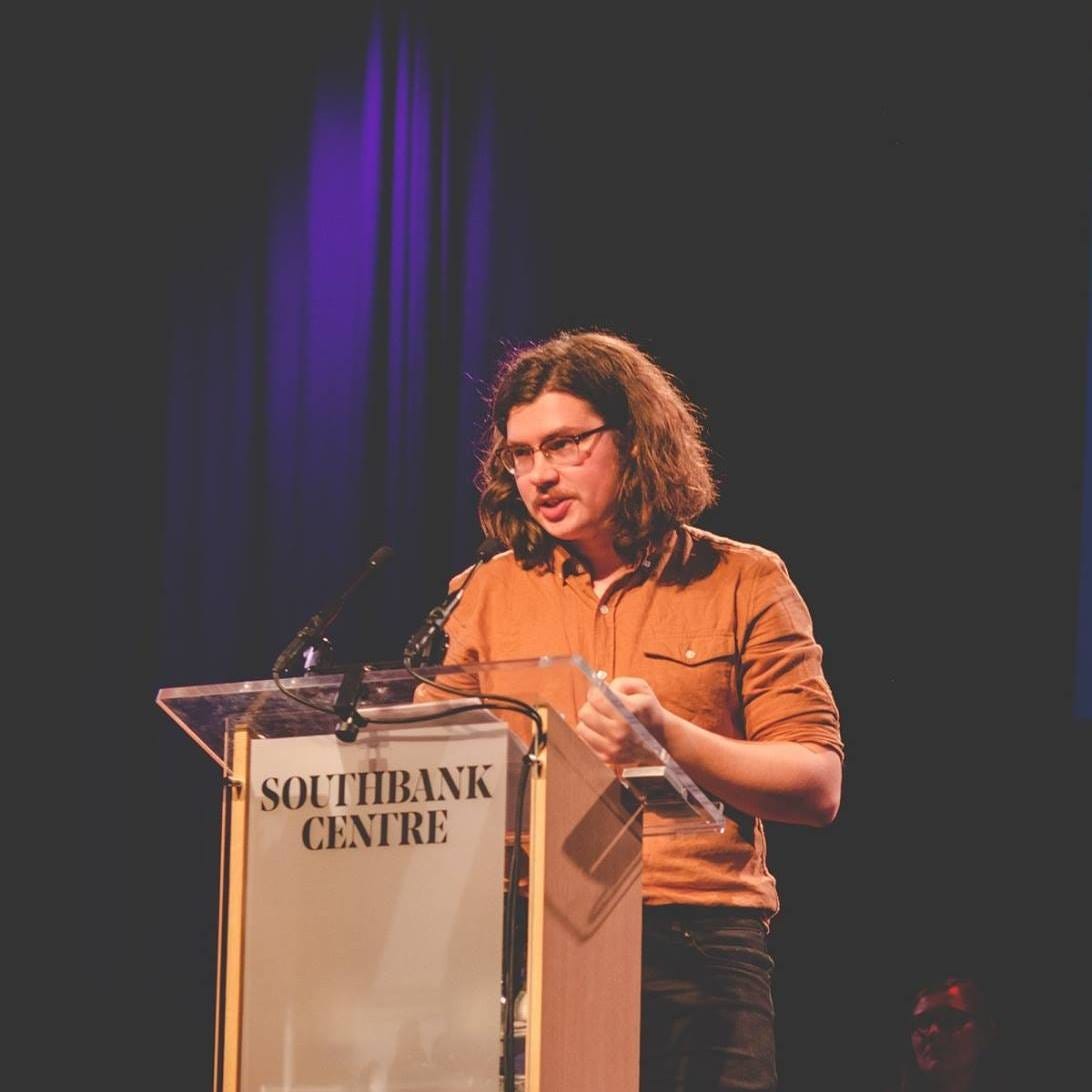
My grandmother died - one of the most important forces in my life as a child - and I remember the call outside Snow Hill Station telling me that she’d gone in the night, in the care-home bed where a few weeks earlier I’d held her weakened hand, which was no longer capable of writing her name, let alone filling in a crossword puzzle, and tried my best to tell her that I was happy. I read an Edna St. Vincent Millay poem at her funeral, face flooding with tears in the middle of the church, an alarming amount to cry in public; a few months later, for the twentieth anniversary of the Foyle Young Poets of the Year award, I was invited to read at the Southbank Centre. This would have been a career highlight, and yet the first of these moments has stayed with me much more vividly than the second.
I don’t think I read the poem below at the Foyle’s event - which I’d written as a tribute to a poem by my PhD supervisor, Luke Kennard, and his own much better piece ‘Cain Reverses Time’ - but it probably tells you where my head was at across those overwrought few months: going back over the history of my family, trying to work out how all the pieces fit together, in the hope that it would help me set myself right. I think the current newsletter has approached that project more successfully, but I was happy to stumble across this early attempt again. At the time of writing, I didn’t realise at the time that what we call ‘catgut’ was often pig intestines anyway, and so as a friend told me recently, it made a fair bit of sense to move on from trading in violin strings to ‘the whole pig.’ This was one of many things I didn’t know when I was younger.
Richard Reverses Time
after Luke KennardI tunnelled into the past to bring back peace. I held it up like a diamond caked in clay: my longed-for birth. My parents’ wedding day. My father’s parents, in a church in Meath,
sweaty with subterfuge. No dice. No good.
I went back to it, cutting through the strata,
back to illiterate farm-hands and carters,
to men you wouldn’t want to meet in the woods,
hard men with faces like a knotted burl,
unrecognisable. And still I dug,
turning up rusted silversmiths who clung
to spoons they’d never eat from, and a girl
packed on a boat with her name unravelling,
whose husband drew the finest catgut strings
to peg to other people’s violins,
and died young as a pig dealer in Ealing.
This week, Richard is getting into all the music I should have heard last year - I’m sure some of it is very good.


